Lifecycle hooks
Components and the application pass through well-defined stages. Methods decorated with
@lifecycle(...) run at those stages, in the spirit of Java's @PostConstruct and @PreDestroy.
import { Lifecycle, lifecycle } from "joltui";

@lifecycle(Lifecycle.BEFORE_INIT)
async loadData(): Promise<void> {
    // runs before the first render
}
The stages
| Stage | App | Component | When |
|---|---|---|---|
BEFORE_INIT |
✓ | ✓ | Before rendering (component) / before the router is created (App). |
EXTENSION_INIT |
✓ | Right after the App's BEFORE_INIT. |
|
BEFORE_INIT_RESOLVE |
✓ | After rendering and after all child components have initialized, before initComplete resolves. |
|
AFTER_INIT |
✓ | ✓ | After initialization has completed. |
BEFORE_RERENDER |
✓ | At the start of rerender(). |
|
AFTER_RERENDER |
✓ | After rerender() and its children have finished. |
|
AFTER_DISCONNECT |
✓ | After the element has been removed from the DOM. |
A component's initialization
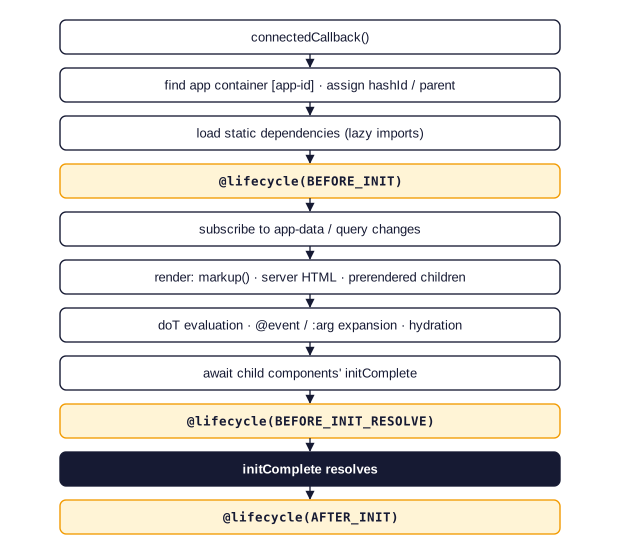
When a component is connected to the document, it:
- locates the App and assigns its
hashIdand parent; - loads its lazy dependencies;
- runs
BEFORE_INIThooks; - subscribes to data and query-parameter changes;
- renders its markup and attaches event listeners;
- waits until its direct child components have initialized;
- runs
BEFORE_INIT_RESOLVEhooks; - resolves
initComplete; - runs
AFTER_INIThooks.
Each hook is awaited before the next step starts, and every step checks that the element is still connected. If it has been removed, initialization stops quietly (Cancellation).
Typical uses
BEFORE_INIT: load what the template needs. The template is rendered right after this hook:
@component({ tagName: "author-profile" })
export default class AuthorProfile extends CustomElement<MyApp> {
    private author: Author | null = null;

    @lifecycle(Lifecycle.BEFORE_INIT)
    async loadAuthor(): Promise<void> {
        const response = await fetch(`/api/authors/${this.args.id}`, {
            signal: this.abortSignal,
        });
        this.author = response.ok ? await response.json() : null;
    }

    override markup = () => html`
        <h2>{{! this.author?.name ?? "Unknown author" }}</h2>
        <p>{{! this.author?.bio ?? "" }}</p>
    `;
}
BEFORE_INIT_RESOLVE: work that needs the finished subtree. Child components have rendered,
but the parent's initComplete has not yet resolved, so anything waiting on the parent also
waits for this hook. Measure the DOM, set initial focus or initialise a third-party widget that
must be ready before the page counts as loaded.
AFTER_INIT: start ongoing activity such as timers, polling and analytics:
private timer: number | undefined;

@lifecycle(Lifecycle.AFTER_INIT)
startClock(): void {
    this.timer = window.setInterval(() => this.invalidate("clock"), 1000);
}

@lifecycle(Lifecycle.AFTER_DISCONNECT)
stopClock(): void {
    window.clearInterval(this.timer);
}
AFTER_RERENDER: restore what a full re-render destroyed, for example re-initialising a
widget attached to elements that have just been replaced.
AFTER_DISCONNECT: release resources. The element's abortSignal has already been aborted
when this hook runs. Listeners registered with { signal: this.abortSignal } are removed
automatically, so the hook is needed only for resources that do not understand abort signals:
@lifecycle(Lifecycle.AFTER_INIT)
watchResize(): void {
    // removed automatically when the element is disconnected
    window.addEventListener("resize", () => this.invalidate("size"), {
        signal: this.abortSignal,
    });
}
Rules
@lifecycledecorates methods. It cannot decorate static, private (#name) or symbol-named methods, nor arrow-function properties.- One method may subscribe to several stages:
@lifecycle(Lifecycle.AFTER_INIT, Lifecycle.AFTER_RERENDER). - Several methods may subscribe to the same stage. They run one after another: base-class methods first, then subclass methods, each class in declaration order.
- Overriding replaces registration. If a subclass overrides a decorated method, only the subclass's version counts. An undecorated override removes the hook; decorators are not inherited by overrides.
- Hooks may be
async; each is awaited before the next runs.
Failures
An error thrown by a hook is wrapped in a MethodExecutionError that names the method and
component and keeps the original error as its cause.
- During initialization stages (
BEFORE_INIT,BEFORE_INIT_RESOLVE), the failure is wrapped once more in anElementInitializationError.initCompleterejects with it,initializationStatebecomes"rejected", and the application's error handlers process it once, even when it also propagates through parent components. - An
AFTER_INITfailure is reported to the error handlers, butinitCompletehas already resolved and stays resolved. - Rerender failures are reported to the error handlers, and the promise returned by
rerender()rejects.
Waiting for a component
For synchronous inspection, use initializationState ("pending", "fulfilled" or
"rejected") and initializationError.